

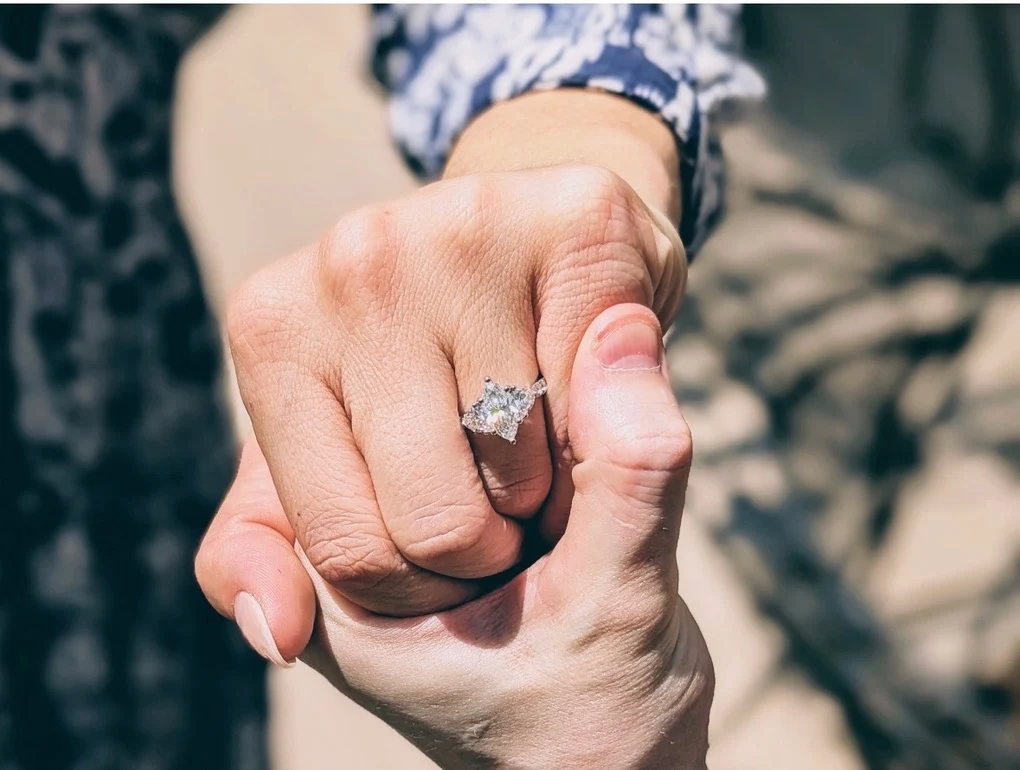
Most people don’t need a custom engagement ring. You need a few clear signs that a ready-made ring won’t do the job.
You keep picturing a stone the high street doesn’t sell
You’ll see the same line-up in most chain stores. Round solitaires and oval halos in white gold and platinum fill most windows. That selection suits plenty of couples and there’s nothing wrong with it.
But you might want something else. You might have a camera roll full of teal sapphires and peach morganite. Perhaps you decided months ago that you want a lab-grown diamond or moissanite. If so, you’ve already felt the friction.
Sales staff don’t mean to push you away from those choices. Their stock is bought months ahead in bulk. They can’t swap a centre stone on request, and they can’t order a one-off cut without disrupting their system. You’ll hear soft pressure to settle. Maybe a paler blue sapphire. Maybe a mined diamond instead of lab-grown.
A custom jeweller works the other way round. The stone comes first, then the design follows it. If you want a sapphire with strong colour that stays clean face-up, the jeweller sources to that brief. If you want a lab-grown diamond in a set size and grade, the jeweller calls suppliers until that stone is on the desk.
That’s the first sign. Your taste is set and it won’t bend to fit the available stock.
You’ve tried on plenty and liked nothing
There’s a particular fatigue that comes after the fourth or fifth store. You try the same shapes. Nothing looks wrong, yet nothing quite looks like you. You leave with brochures you’ll never open.
Don’t ignore that feeling. It’s useful information.
If you’ve already worn out the local malls and jewellery quarters without feeling a spark, you aren’t being picky. You’re looking for a ring that doesn’t exist yet. Ready-made jewellery depends on broad appeal because each design has to sell to thousands of people to earn its place in the case. Your preferences might sit outside that middle.
We see this often with couples who want small personal touches. Engraving inside the band and mixed metals matter more to them than a brand name. A hidden stone or a hand-stamped date can matter more than a bigger halo. Those details rarely show up in stock because they can’t be produced at scale.
Think about what you compromised on each time. Perhaps it was the stone shape or the band width. If one detail keeps blocking the yes, that’s your brief for custom.
There’s an heirloom waiting in a drawer
Many of us have one. It may be a grandmother’s diamond in an old yellow mount or a mother’s cluster ring with worn claws.
You can’t take that to a chain store and expect a useful answer. Most aren’t set up to remove stones and reuse metal. An heirloom doesn’t fit their usual process.
A custom jeweller is set up for it. The job starts with an assessment. The jeweller checks the condition of the stones, identifies the alloy of the old metal and works out whether it can be melted cleanly. They also consider whether a diamond can be lifted without chipping the girdle. Those questions decide whether you reset, recut or reuse metal for a new shank.
There’s also the design problem. Old cuts often sit high. Old gold has a warm tone that can look off next to new white metal. A good custom design takes those details into account. It might keep the original centre stone low in a new head. It could melt family gold into a new band and pair it with fresh platinum. The point is structural as much as sentimental. The heirloom has to be held safely for daily wear.
If you have sentimental material at home, custom isn’t simply a luxury. It’s the only practical route.
Standard sizes never feel right
Some fingers don’t suit stock sizes. Very small sizes and very large sizes sit at the edge of what stores carry. Wide bands and low, protective settings also fall outside the norm. Resizing has limits.
Resizing stretches or compresses a ring that was made for someone else. Go more than a couple of sizes and the shape distorts. Shoulders thin. Engraving stretches. A wide band that felt fine in a size M can pinch and spin in a size Q because the contact area is totally different. You shouldn’t have to live with that.
The ring has to be built around the finger, not forced onto it.
Custom geometry starts with the actual finger. Knuckle size and finger shape determine the inner profile. A large knuckle with a slimmer base needs a slightly tapered fit that slides over and then sits still. A short finger with a wide band needs curved inner edges and balanced weight so it doesn’t dig in. Daily habits matter too. Nurses and new parents need low profiles and smooth edges that won’t catch.
This is unglamorous work. But you’ll feel the result every day for decades. If comfort has been the blocker in stores, take it as a sign.
You care where the diamond comes from
Provenance matters more now than it did ten years ago. Plenty of buyers ask about conflict-free stones and traceable supply. They want to know where a diamond was mined and cut, with paperwork to support the claim.
Stores can’t always answer that. Their diamonds may come through large parcels with mixed origins. Staff can say the supplier follows the right process, but they can’t necessarily show you a specific mine or cutter for the stone in the window.
Custom gives you more choice. You can request a mined diamond with full traceability from a named producer, or a lab-grown diamond from a set grower with disclosed methods. You can compare two or three stones side by side and choose based on origin and character rather than grade alone. A good jeweller will show grading reports from GIA or IGI, giving you independent proof rather than just a shop card.
If that checklist sounds like you, searching for custom engagement rings Perth will surface local studios with verifiable portfolios and workshop access, which is exactly the kind of accountability mass-market brands can’t give.
That face-to-face link matters. You can meet the person who will cut the seat and set the stone. You can ask about sourcing and look through past work. It’s harder to hide poor practice when there’s a bench down the hall.
You want a say in how it’s made
Some couples want the story as well as the ring. They want to remember choosing the stone together and debating claw shapes over coffee. That shared memory becomes part of the proposal.
The bespoke jewellery process gives you that experience. It starts with a conversation and hand sketches. You bring photos, preferences and dislikes. The jeweller draws options that suit your budget and finger.
Then you approve jewellery CAD and 3D renders before any metal is touched. You’ll see the ring from above and in profile, including band thickness and stone height in millimetres. You can request a lower setting or a softer shoulder. Changes on screen cost little. Changes in metal cost a lot, so this stage removes much of the risk from the job.
After approval, the ring goes through lost-wax casting and hand finishing. A wax is grown or carved, cast in your chosen alloy, cleaned and set under a microscope. Good craftsmanship shows here. Seats are cut evenly and claws sit level. Edges are soft where skin meets metal. You don’t need to know bench terms to see the result. The finished ring looks balanced and sits flat.
If that kind of involvement sounds fun rather than stressful, you’re well suited to custom.
The maths looks better when you control it
Retail pricing can be confusing. A price tag covers rent, staff, marketing and slow-moving stock as well as gold and stones.
Custom pricing is usually plainer. You pay for metal by weight and finish, the centre and side stones at their market value, and the jeweller’s labour according to time and skill. You decide where the money goes. If you want a smaller centre stone with a heavier band that will last, you can choose that. You can also put more of the budget into cut quality rather than size.
Couples in recent years have spent roughly $5,900 on a diamond engagement ring on average (The Knot). That figure helps explain why value thinking matters. At that level, paying for overhead leaves less for the stone and build. Paying a fair maker’s price keeps more of it in the ring itself.
Paperwork closes the loop. Once finished, have the piece appraised for insurance value and keep the grading reports with the receipt. An independent jewellery appraisal records weight and replacement logic. Insurers value that clarity, and so will you if a claw ever lifts or a stone chips. You’re paying for decisions, not display cases, and the documents prove it.
Reasonable budgets can go further here because you control the trade-offs.
When custom is the wrong move
Custom isn’t always the smart choice. It’s worth saying plainly.
Don’t go custom if the proposal is less than three weeks away. Good work takes time. Design, sourcing, casting and setting can’t be rushed without risk. A rushed ring may have thin shanks and hurried setting, and you’ll see the consequences within a year. If the date is fixed, buy ready-made and do it well.
If you’ve already fallen for a specific in-stock ring, that’s your answer. If you tried it on and can’t stop thinking about it, keep things simple. Don’t try to improve on a sure thing by copying it with a few tweaks. You’ll spend more and may like the result less.
Don’t go custom if you hate making decisions. The process asks for input. Stone choice, band width and other details all need a call. If that sounds draining, walk out with a stock ring you like and save your energy for the wedding.
A good jeweller will tell you the same. If the timeline is too tight or the brief is too vague, they’ll point you towards stock. That honesty is how you know you’ve found the right bench.
A custom ring suits buyers with a clear reason for choosing it. That might be a set stone preference, an heirloom to honour or a finger that stock sizing forgets. You may care about tracing the stone’s origin, enjoy the making process or want more control over how the budget is spent. If two or more of those signs fit, stop scrolling through stock pages and start talking to a local jeweller who can draw what you actually want.
